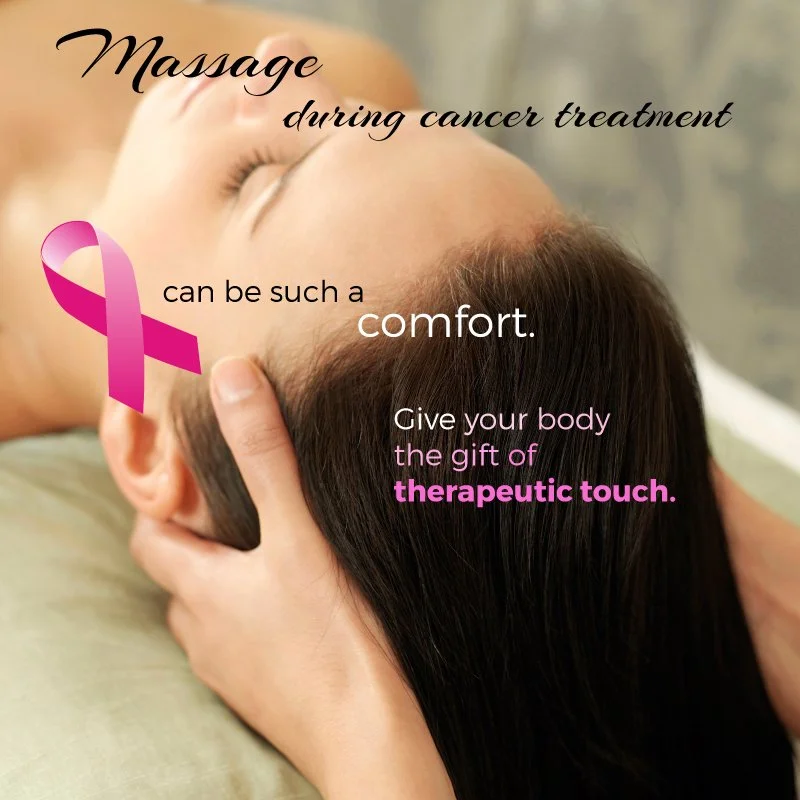
Can You Have A Massage If You’re Having Cancer Treatment?
The simple answer is YES!
Don’t be afraid of guiding yourself or someone you know to a massage session while going through treatment for cancer. There’s no reason why anyone who has a cancer diagnosis should avoid massage; in fact, it can be an incredibly life-affirming treatment that should boost wellbeing and help with the stress of the gruelling treatments that accompany the condition.
Having a massage while having medical cancer treatment can really put you back in touch with your body again. It can feel almost alien while you’re being examined and prodded by medical experts, given harsh chemical cocktails and treatments that make you feel not so great. Then having to go to test after test. The simple pleasure of human touch through massage can help reconnect you with your body, making you feel more human and ‘normal’ at a difficult time. If you want to talk about how you’re feeling with your therapist, it’s a safe place to chat and share your thoughts and fears in a safe space.
You should feel relaxed after a massage session; your therapist will listen to you and adapt techniques to fit your needs. It can be nice just to feel listened to when you’ve been seemingly at the mercy of the medical profession.
It doesn’t just feel nice; clinical studies have shown that massage can reduce symptoms such as stress, nausea, pain, fatigue, and depression, which are all too common when dealing with a serious illness.
Worry not! – There are research studies that show massaging muscle and soft tissue doesn’t spread cancer cells – that’s a myth.
A relaxing massage is perfectly safe for people at all stages of cancer treatment. However, the massage therapist will be careful to avoid any treatment or tumour sites while massaging you, to prevent any discomfort.
The myth that massage can spread cancer came about because some people believe that cancer-affected cells can be moved around the body via the lymphatic system. This isn’t true because lymphatic fluid flows naturally as we move our bodies; it can’t cause cancer to spread.
Cancer develops and spreads because of changes to a cell’s DNA, not through cells being circulated through the body. There’s nothing to worry about!
Scientific studies have shown that massage may reduce:
· pain
· fatigue
· nausea
· anxiety and depression
in people going through treatments like chemotherapy and surgery.
What Are the Health Benefits of Massage for Cancer Patients?
People who’ve had massage therapy sessions during their cancer treatment say that they’ve noticed a wide range of positive effects afterwards. These include:
· Better sleep
· Improved healing of scar tissue
· A better quality of life
· More mental clarity
· Better range of movement.
A large American study from 2004 [1] looked at the effects of massage therapy on almost 1300 people with cancer over three years. The study found that massage therapy reduced their pain, nausea, fatigue, anxiety, and depression, and the longer the massage sessions, the more relief they reported.
Another smaller study [2] looked at how safe and effective massage was in reducing stress hormones in people who had blood cancer. People were given aromatherapy, massage, or rest; massage significantly reduced the amounts of stress hormones in the people who took part in the study.
So, if you, or someone you know, is dealing with cancer, or has just been through treatment and needs a pick-me-up, choose massage.
References
1 Fellowes D, Barnes K, Wilkinson SSM. Aromatherapy and massage for symptoms relief in patients with cancer. Cochrane Database of Systematic Reviews 2008, Iss 4.
2 Stringer J et al. Massage in patients undergoing intensive chemotherapy reduces serum cortisol and prolactin. Psycho-Oncology 2008 Oct; 17 (10): 1024–31.

Massage for Older People: The Benefits of Touch
Massage for Older People: The Benefits of Touch
Most of us enjoy a massage to ease our tension and soothe our aches and pains. But somewhere along the way, we started treating massage like something you "age out of" — a young person's indulgence, best left to marathon runners and stressed-out desk jockeys. Nothing could be further from the truth.
Elderly people can benefit from regular massage just as much as anyone else — arguably more. It's enjoyable, relaxing, and non-invasive, and it's one of the few remaining ways many older adults get a consistent, caring human touch in their daily lives. No poking and prodding, no side effects, no waiting room full of…the things that waiting rooms are full of. Just a skilled therapeutic touch.
There's no doubt that regular massage can improve quality of life. That applies at 25. 35. 45. It applies at 85. The techniques just need to flex a little.
The Effects of Massage on Older People
The positive effects of massage on older adults' health are well documented —Research consistently shows that even the gentlest massage can meaningfully improve circulation and support the nervous system. So, if a lighter touch is needed for a client with a bit more frailty, it can be just as effective as a deep-tissue or sports massage for an athlete. Pressure isn't the magic ingredient here. It’s the technique.
Gentle geriatric massage stimulates circulation naturally, without discomfort — which is exactly why so many older adults are willing to trust an experienced therapist when they're feeling tense, achy, or just in need of a little healing touch.
Here's the part that tends to surprise people: massage doesn't carry the side-effect baggage that comes with a lot of other treatments, and it doesn't interact with medications older adults commonly take for conditions like diabetes, depression, Parkinson's, or dementia. In some cases, physicians have been able to reduce a patient's reliance on certain medications through consistent massage therapy. Not bad for something that also feels good.
There’s a physiological piece worth mentioning as well. A purposeful, caring touch can lower cortisol levels (your stress hormone) and encourage the release of oxytocin (the ‘connection hormone ‘). For someone who isn't hugged as often as they used to be, that's not a small thing. That's the whole thing.
Helping Counteract the Signs of Old Age
Elderly people often live with symptoms brought on by arthritis, diabetes, heart disease, and stroke — conditions that can chip away at mobility and circulation over time. This is sometimes attributed to the fact that many older adults quietly deal with depression or loneliness. "Just get a massage" sounds almost too simple. But simple doesn't mean ineffective.
Geriatric massage doesn't only support the body — it can meaningfully ease the depression and isolation that so often ride along with aging. It gives older people access to something the rest of us take for granted: comforting, attentive touch. There's even evidence that degenerative conditions like Parkinson's respond positively to regular half-hour massage sessions, with some clients reporting reduced tremors and easier movement afterward.
Massage in Elderly People Can:
Help boost quality of life and self-esteem
Improve sleep quality
Relieve stress, depression, and even loneliness
Provide relief for headaches and other aches and pains
Restore some lost mobility due to Parkinson's disease, arthritis, and other limiting conditions
Support circulation, which can help reduce swelling in the hands, feet, and ankles
Give someone a routine to look forward to — which matters more than people give it credit for
How Is a Geriatric Massage Different?
Geriatric massage draws on many aspects of general massage therapy, but everything is thoughtfully adjusted to the realities of an aging body. It's not "massage, but slower." It's massage, but smarter.
Shorter sessions. A geriatric massage typically runs shorter than a standard session — usually no more than about 30 minutes — because a long treatment can be tiring rather than relaxing for an older client.
Extra-gentle techniques. Movements are designed to soothe and improve circulation rather than dig in. This matters a lot for clients with a diabetic foot condition, thinner or more delicate skin, or a build-up of tension that needs a careful hand.
Focused hand and foot work. A gentle massage of the hands and feet can ease joint swelling and stiffness — areas that are easy to overlook but can cause a surprising amount of daily discomfort.
Careful, targeted pressure. Where it's appropriate, slightly firmer movement, friction, and pressure can help improve flexibility in larger areas like the shoulders — always scaled to what that individual body can actually handle that day.
A slower, more communicative pace. A good geriatric massage therapist checks in throughout, watches for nonverbal cues, and adjusts on the fly rather than running a fixed one-size-fits-all autopilot routine.
What to Look For in a Geriatric Massage Therapist
Not every massage therapist is trained to work with older or medically complex clients, so it pays to be a little choosy here. Look for someone who:
Has specific training or experience in geriatric massage
Takes a full health history before the session — medications, conditions, all of it
Is comfortable working around mobility aids, wheelchairs, or a hospital bed if needed
Communicates clearly and checks in throughout, rather than just clocking the 30 minutes
Is willing to coordinate with a client's physician or care team when it's appropriate to do so
A good therapist isn't just performing a treatment. They're building trust — and for many older clients, that trust is just as valuable as the massage itself.
A Gift Worth Giving
Massage is a therapy that people of all ages can enjoy — yes, all ages. If you know someone who assumes it's "not for them" because they're older, maybe a bit frail, or managing a chronic condition, consider treating them to a session. Watch what happens to their shoulders. Watch what happens to their face. Touch doesn't stop mattering just because we get older — if anything, it starts mattering more.
Disclaimer: This post is intended for general education and informational purposes only and isn't a substitute for medical advice. Always check with a physician before starting massage therapy for a new or existing health condition.
Essential Oil vs. Fragrance Oil: What Scents Does That Make? Part II
In Part I, we covered the basics: what actually separates an essential oil from a fragrance oil, why "chemical-free" is a myth, and why the biggest difference is felt in your wallet when you reach for the pure rose oil versus the lab-made version. If you missed it, go check it out first. It’s a good read— this one picks up right where that left off.
Remaining on the course of the what, where, why, and what-for: now you know which oils to look for based on your personal needs. Now it’s time to relearn the grading system as you know it, and brush up on your Latin! Just kidding…but not really. The term “grade” can be misleading when used on some product labels. No governing agency oversees, regulates, or “grades” the standards of essential oils. Different companies trademark the term to enhance brand image. Brilliant- yes. Effective- yes. Guaranteed authenticity of its contents- not necessarily. This does not mean that a ‘therapeutic grade’ essential oil brand that you may know, love, and trust is not of good quality or dishonest. It just means to look for other indicators. Like…the botanical or Latin name. They all have one. For example, your Tea Tree essential oil should also be labeled as Melaleuca Alternifolia. Peppermint: Mentha Piperita. It should also label the country of origin and how the plant was sourced.
Let’s go Inside Out.
You’ve done your homework. Labels read. Deciphered which oil you need for what. So, what’s going to happen when that scent hits you, and what will start to happen in your brain?
Smell is the only sense that has a VIP pass directly to the brain. Specifically the limbic system- the part that is tied to your emotions and memories. So much so, and so quickly, it happens before your logical part can react. You know, like how a certain smell can put you someplace and make you smile or drop your shoulders and shift your entire mood before you even realize why. Ok. So what, right? Here’s the what (from part I). Upon that first recognizable smell, your limbic system does not run a background check to confirm if those lavender molecules came from a field of flowers or a lab full of beakers. For the most part, the same receptors are being reached, triggering the same emotional response.
Carry on.
If my brain can believe fragrance oil is essential oil and essential oil is fragrance oil, then let’s call the whole thing off? No. Not exactly. Essential oils carry dozens of compounds in addition to just what makes the calming smell. Components like linalool and linalyl acetate contribute to the physiological relaxation effects of lavender, not just the psychological effects that may trigger a memory or emotion. Fragrance oils are specifically designed to target the scent aspect, not so much the other. Essential oils can do both. We can be pretty sure there is no “fake calm” from using fragrance oil over essential oil.
Essential oils are strong, and shouldn’t be used directly on skin without something to make it safely spreadable and reduce irritation. Enter carrier oils. Carrier oils are oils that are intended to do just what they say. They are the vehicle that does the driving (carries); the essential oil is (the passenger), to its destination, but softens (makes it safe) the ride and gives directions (soften, moisturize, etc). They are usually light oils with little to no scent to them. The most common:
· Sweet almond oil — light, absorbs well, a solid all-around choice
· Jojoba oil — closest to your skin's natural oils, great for sensitive skin (great for someone with a nut allergy).
· Fractionated coconut oil — stays liquid, no greasy feel, doesn't stain sheets (a plus for when using for massage)
· Olive oil — the most accessible- you probably have some in your kitchen as you read this.
What smells nice, or what you are trying to feel, can be a combination of both. Some notable pairings:
· Winding down / lowering stress: lavender, chamomile, or sweet marjoram
· Waking up / mental clarity: peppermint, rosemary, or lemon
· Grounding / easing tension: frankincense or vetiver
· Lifting mood: bergamot or sweet orange (these are phototoxic. Skip exposure to the sun after using.)
How Does This Relate to Massage
The pleasant smell of (fragrant oil) in the waiting room is doing one job. The essential oil being used while you are on the table is doing another. While still being introduced through the same limbic system, it is also reinforcing what your body is already doing physically as it shifts into your parasympathetic nervous system (the rest-and-digest state). Using the right essential oil along with the suitable carrier oils allows both types of oils – fragrance and essential be equally useful, just working differently and doing their own different jobs.
Part I + Part II = What Exactly?
Scent doesn't necessarily need to be "natural" to provide an emotional response — memory and association do that on their own. However, if the goal is more than just trying to achieve a mood, and you intend to achieve an actual physiological assist in addition to the emotional one, that's where a genuine essential oil, chosen deliberately, would be the best option. That is when that previously discussed price difference is introduced- but it is worth the extra cost.
Disclaimer: This post is intended for general education and informational purposes only and isn't a substitute for medical advice. If something feels off when using any oil topically or otherwise, stop use and see a physician right away.
Essential Oil vs. Fragrance Oil: What Scents Does That Make? Part I
Have you ever browsed a store and wondered why two oils can sit on the same shelf, practically smell the same, yet the price tag differs so much? The simple answer is: they're not the same thing. "Essential oil" and "fragrance oil" might seem like just different ways of saying the same thing, but what's actually inside those bottles that tells the story, one that could be helpful to you in the future when putting something on your skin, in your diffuser, or getting ready for that aromatherapy session.
Let’s begin with the basics. But before we do, be aware that this is not an argument of natural vs. chemical, or natural good, synthetic bad. That’s more of a marketing narrative rather than a proven factual one. So, how about we just let that rest there.
So What's the Difference?
Essential oils come straight from plants — think lavender flowers, eucalyptus leaves, or orange peels. The oils are extracted through various processes like steaming, distillation, cold pressing, or solvent extraction. The result in that little (hopefully amber) bottle is “essentially” (get it?) the plant's own natural compounds, with nothing added to it.
Fragrance oils are scents that are blended in a lab to smell a certain way. Altered, so to speak. Like creating a recipe for a specific aroma. They may contain synthetic ingredients, natural extracts, or a mixture of both. They're designed to have a pleasant smell and linger consistently. This is what makes them a popular and more economical option for candles, lotions, and perfumes. However, smelling like lavender and actually being lavender are not the same thing.
"Chemical-Free" Isn't Really a Thing
This catches a lot of people off guard, but everything with a scent is made of chemicals — yes, even your favorite natural essential oil. Lavender oil, for example, is made up of dozens of natural chemical compounds. So, when a product claims to be "chemical-free," maybe take it with a grain of salt?...which is also a chemical…so…
The point is that technically, there is no such thing as a chemical-free scent — natural or otherwise.
Another misconception worth mentioning: natural does not automatically mean safe, and synthetic does not automatically mean harmful. There are essential oils like citrus oils, clove, or bergamot that are completely natural and can cause significant skin irritation or phototoxic burns. Not safe
Some synthetic aroma chemicals are designed specifically to replace natural ingredients that cause problems. A lab-made version can capture the scent while leaving out the elements that trigger allergies and irritants. Sometimes, synthetic is actually the cleaner choice. Sometimes.
The Cost Is Real
One thing that isn't a gimmick: natural essential oils generally do cost more than synthetic fragrance oils, often by a wide margin. The price difference comes down to what it takes to fill that bottle. A straightforward example- It can take 10,000 pounds of rose petals to get one kilogram of oil. Jasmine takes at least 8,000 blossoms. Both flowers have to be hand-picked at dawn. Tea tree, mint, and eucalyptus are much more accessible and less laborious to harvest. Synthetic fragrance oils made in a lab can easily bypass all of those components, being free of seasons or geography, which cuts costs a great deal. So, if it looks like a rose, quacks like a rose, and smells like a rose, it doesn’t necessarily mean it’s a rose.
So, What Should You Look For?
It really comes down to your intended use.
If it’s true aromatherapy, look for a pure essential oil. The label would normally have the plant name and the country of origin.
For anything topical (planning to use on your skin), natural or synthetic is important, but it is secondary to its compliance with safety. The IFRA (International Fragrance Association) is the organization that standardizes and regulates compliance.
If you just love the scent — for a candle, room spray, or linen mist — fragrance oils are sufficient. It’s ok to not break the bank using essential oils for your laundry.
If natural ingredients are a priority for you, just look for more than “natural” on the label. Full transparency of the ingredients is far more important than the marketing tactic.
Basically, there is no single right answer — just the right one for what you need.

Trigger Points and Muscle Knots
What’s a trigger point?
If you’re a regular massage-goer, the concept of a muscle knot is probably something you’re well aware of, but what exactly are they? And what’s the relationship between a muscle knot and a trigger point?
Trigger points are tender spots on your body that ‘trigger’ or cause discomfort. These tender spots are common, and many of us have them, but for some people, they can become really troublesome. They are common in hot spots like the shoulders, neck, back, and glutes. But they can pop up just about anywhere, and in some people, they can cause a lot of pain.
A trigger point is like a ‘knot’ in your muscle, or the fascia (the thin connective tissue around each muscle), which is why they are often referred to as a muscle knot - a cluster of muscle fibers that have contracted and simply refused to let go. To a massage therapist, it feels like a hard, tight band around the muscle. Trigger points in muscles are ‘myofascial trigger points’ – and there are other types of trigger points that can occur around the body, on your skin, ligaments and tendons, and on scar tissue.
How can you tell if you have a muscle knot or trigger point?
Trigger points can be surprisingly easy to miss — or easy to confuse with other conditions.
You’ll be able to tell where your own trigger points are; if you touch them with any kind of pressure, you’ll notice they start to hurt, or hurt more. They are often situated close to problem areas for you as well, so if you have back issues, your trigger points are likely to be around your back, neck, and shoulders, although this isn’t always the case. The range of sensations you might feel from a trigger point can be quite wide, too; anything from intense pain to a dull, throbbing ache. Some people feel ‘pins and needles’ or numbness. Some signs to look for:
Referred pain
Pain that radiates to a predictable area away from the actual knot
Restricted range
Stiffness and reduced movement in the affected joint or muscle
Twitch response
The muscle visibly twitches when the knot is pressed on
Sleep disruption
Aching or throbbing that worsens at night or when lying down
So, what causes trigger points to flare up? One theory is muscular overload - if you’ve been working out too hard or overdoing it, or just not been taking care of your posture.
How are Trigger Points treated?
If you notice a sore spot and want to see a massage therapist for advice, always consult with your medical provider first, just to make sure that any swelling or soreness is just due to muscular stress and nothing more serious.
A good massage therapist will be able to work on your trigger points and muscle knots, gently but firmly releasing them. They can also help you with massage techniques to try at home that will ease any discomfort and help to prevent muscle knots from building up again.
Trigger points and tender spots can cause a huge amount of pain and discomfort, often restricting your movement and your ability to do the activities you want to. But with some action on your part, you can alleviate this sort of pain from your day-to-day!
The good news: trigger points respond significantly well to treatment. With the right approach — and consistency — most people experience a great deal of relief. The more effective options include:
Therapeutic massage: Targeted pressure techniques break the pain-tension cycle, restore circulation, and release contracted fibers
Heat therapy: Applying warmth increases blood flow to the area, relaxes taut muscle bands, and reduces.
Stretching & movement: Gentle and controlled stretches help lengthen the contracted fibers and prevent knots from re-forming
Self-massage tools: Foam rollers and massage balls allow you to apply continuous pressure between appointments with your therapist.
Posture correction: Addressing the root cause — movement habits, your set-up at the desk, car, and muscle imbalances, helps to prevent trigger points from recurring.
Why massage is the most powerful tool
Massage therapy isn't just relaxing — for trigger point pain, it's genuinely therapeutic. A skilled therapist doesn't just rub muscles; they systematically locate the bands under tension, apply a sustained compression (a fancy term for targeting and holding pressure), and guide the tissue through techniques that break the pain cycle at its source.
Within just a few sessions, most clients notice a dramatic reduction in both the intensity of their pain and the frequency of flare-ups. Range of motion improves, sleep quality rises, and the chronic tension seems to fade. Note at least a few sessions. Don’t think you can undo a heap of mess in 60 minutes or less.
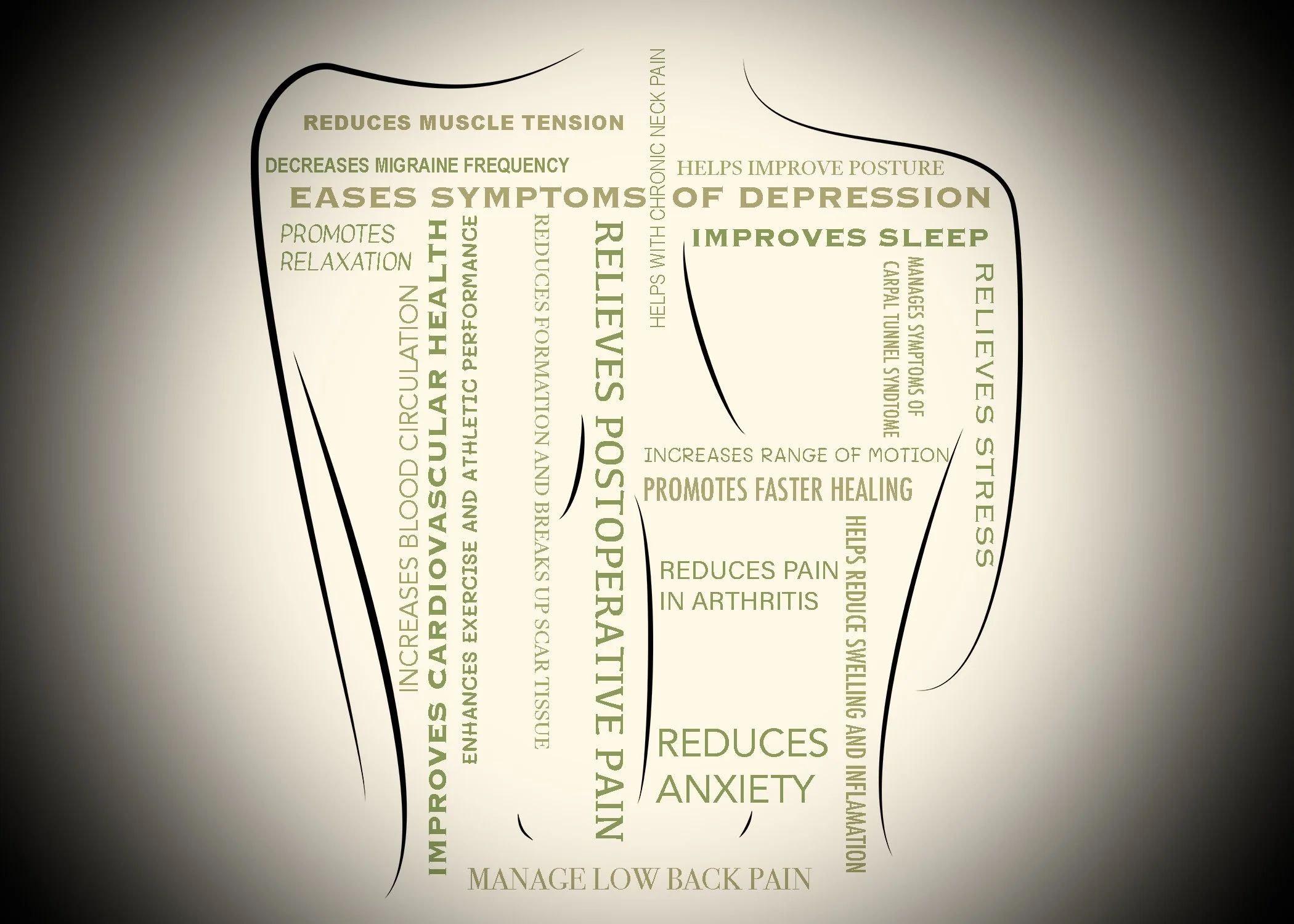
Common Health Problems: What can Massage do for YOU?
Massages are often sold as purely indulgent treats you get when you visit a spa or go on vacation, but there’s so much more to massage than just a feel-good treat. There are plenty of symptoms caused by many health problems that can be reduced and even eliminated with regular massage. Regular massage can do a lot more for your body than just help you unwind. Here are eight health conditions that massage can genuinely help with. A few will seem obvious. Others might be a new revelation.
Stress
Okay, this one's not a surprise. But it goes deeper than just "feeling relaxed." Regular massage actively lowers your blood pressure, improves your sleep, and reduces cortisol — the hormone your body pumps out when you're stressed. Over time, it's even been linked to a lower risk of heart disease. Not bad for an hour on a table.
Lower Back Pain
If you spend most of your day sitting at a desk, your lower back is probably not thrilled about it. Poor posture and long hours in a chair are two of the biggest culprits behind back pain — and massage can target exactly that. It's why more and more employers are actually bringing massage therapists into the workplace.
Sports Injuries
Whether you've overdone it at the gym or you're nursing a longer-term injury, massage helps muscles and tendons heal faster. It also helps manage ongoing pain. Making a habit of looking after your muscles is helpful in avoiding getting hurt again in the first place.
Joint Stiffness
For anyone dealing with arthritis or stiff, achy joints, massage can be a welcome relief. A 2013 study found that people with rheumatoid arthritis felt noticeably better after just four weekly massages. Better range of motion, less pain in the hips, knees, and shoulders — it adds up.
Poor Circulation
Bad circulation causes all sorts of problems in the body. Massage gets your blood moving, helps deliver nutrients to your tissues and organs, and flushes out the lactic acid that makes your muscles sore. It also supports your lymphatic system, which is essentially your body's waste removal crew.
Migraines
We still don’t fully understand what causes migraines, and there's no cure — but massage has been shown to reduce how often they happen and how bad they feel when they do. If your migraines tend to be stress-related, you may find massage especially helpful.
Skin Health
Your massage therapist sees a lot of skin. That means they're sometimes the first to notice an unusual spot or change you might have missed. Beyond that, the improved circulation from massage. Also, the nourishing oils used during treatment can leave your skin not only looking good, but feeling better too.
Allergies
This one surprises most people. Massage stimulates lymph flow, which gives your immune system a boost and can take the edge off allergic reactions. Some therapists can even tell you're an allergy sufferer just from the feel of your lymph nodes — they tend to feel tender or swollen.
Of course, you don't need a health reason to book a massage. But if any of these sound familiar, know that you're doing your body a genuine service every time you go. So, stop looking at massage as a treat. “It’s not treating yourself. It’s treating yourself well.”
Why Language Matters in Massage Therapy (and Why “Masseuse” Isn’t the Same)
Why Language Matters in Massage Therapy
“Sticks and stones…” we know the rest. But in reality, words can and do cause harm—especially when they shape how a profession is perceived. Words carry weight. In massage therapy, language doesn’t just describe the work; it influences how the entire field is understood, respected, and protected. Using the wrong terms isn’t harmless—it has real consequences.
Massage Therapist vs. Masseuse: What’s the Difference?
There’s an ongoing debate around terms like “masseuse” and “massage therapist.” Same difference! Tomato-tomahto! But NO, it’s not the same. Very different in fact. On the surface, it may seem like a small difference—semantics, even. But within the profession, that distinction matters. Professional Massage Therapists are licensed healthcare professionals who practice therapeutic, evidence-informed bodywork and are bound by professional and ethical standards.
It’s 2026, and terms like “masseuse” and “massage parlor” are outdated because they are frequently used in code with sexy industries like exploitation and trafficking. This is a misleading and harmful connotation that blurs the line between legitimate massage therapy services and illicit practices. An important line—one that affects how the public, law enforcement, and even the entertainment industry perceive the profession.
Why Language Matters for Massage Therapists
This isn’t about being overly particular or correcting people just for the sake of it. When a massage therapist clarifies their title, they are advocating for the integrity of their work and the safety of their field. Everyday many people call legitimate massage therapists seeking sexual services. Massage therapy is licensed for a reason. It involves touch—something vulnerable for both practitioner and client—and requires clear ethical and professional boundaries. Although it may be unintentional, referring to a massage therapist diminishes the nature and integrity of the profession(al).
The Real Impact on the Massage Therapy Profession
Massage therapists are not competing with these unauthorized industries. It’s a navigation through the involuntary crossfire of being associated with them. That misunderstanding leads to real consequences, including safety risks, and reduces the credibility within healthcare settings.
The more clearly we define massage therapy—through our language, our standards, and our professionalism—the less room there is for confusion and harm to exist.
How You Can Support the Massage Therapy Industry
The way you speak about massage matters more than you think. Using correct terminology helps elevate the profession and reduce harmful misconceptions.
Here are simple ways how you can help:
Say “massage therapist” instead of “masseuse.”
Refer to businesses as massage practices or clinics, not “parlors.”
Recognize massage therapy as part of health and wellness care
Final Thoughts
The more clearly we define massage therapy—through our language, standards, and professionalism—the less room there is for confusion and harm.
When you know better, you do better. We’re all learning every day—so take a moment to share that understanding. You might change how someone sees an entire profession.

Bad Posture Can ‘Sneak Up’ as Shoulder Pain as You Age
Shoulder pain in older adults often appears suddenly, as if caused by a sudden trauma or injury. But for many, athletic trainers say, shoulder injuries are often the result of musculoskeletal conditions directly associated with aging, and, more specifically, weakening posture.
Some people often think ‘I slept on it wrong’ or ‘I pulled something in my shoulder,” but the truth may point to something more long-term. The pain might be something that’s been developing over time, perhaps due to taking on a tighter, less upright posture as we age.
According to the National Institutes of Health (NIH), anywhere from 44 to 65 percent of all shoulder pain complaints can be attributed to a condition known as shoulder impingement syndrome – also known simply as “shoulder impingement.”
Shoulder impingement results from the chronic and repetitive compression of the rotator-cuff tendons in the shoulder, causing inflammation, pain, weakness, and a decreased range of motion in the joint. Usually, repetitive overhead movements are taken on by athletes like golfers, swimmers, and tennis players. However, as we age, changes in posture lead to tightness in the back and neck, along with arching of the spine, which can create conditions ideal for the development of shoulder impingement. As time progresses, this can lead to tendinitis or even rotator cuff tears.
The key to preventing shoulder impingement as you age, says, is regular mobility – moving and stretching your shoulders daily helps to stay loose and counteract the effects of declining posture. Some exercises to add to your regular regimen are:
Back Extension/Shoulder Flexing Stretch: Sitting in a chair, hands clasped together, reach your arms high above your head and slowly reach backward, extending your head and hands behind you. Hold for a few seconds, relax, and then repeat.
Backward Shoulder Extensions: Standing upright, your fingers interlaced behind your back, slowly lift your arms away from your buttocks and toward the ceiling. Lift as high as you can. Keep an upright stance, hold for a few seconds, release, then do it again.
Up-Back Shoulder Reaches: Reach one arm behind your back and, palm facing out, slowly reach up the small of your back toward the space between your shoulder blades. Hold for a few seconds, release, then do the same with your other arm. Repeat one time each.
Down-Back Reaches: Reach your hand behind your head and down your back. Hold for a few seconds, release, and then do the same with your other arm. Repeat one time each.
Maintaining healthy shoulders and preventing the onset of impingement translates into staying active, allowing you to continue lifting the grandkids, comfortably reaching that top shelf in your cabinet or closet, and even sleeping more comfortably. Regular massage with incorporated stretch therapy can help keep you on that path toward pain-free motion.
20 Self-Care Ideas for 2026
Welcome to the new year! It’s time to put 2025 in the rear-view mirror and start putting ourselves first with a self-care routine that gives us the inner strength to deal with whatever the new year brings.
It’s no secret that people who don’t give themselves the care that they give to others will usually end up stressed and burned out. To stop this from happening, develop an attitude of nurturing. Take care of your mind, body, and soul every day, in small ways and occasionally (but regularly) bigger ways too. Self-care is non-negotiable these days, but you have to make an effort to make space for it. Here are a few ideas for things to do that rebalance, re-energize, and replenish.
Do something physically energizing
Whatever floats your boat, make time for it if it makes you feel good. This could be a series of stretches, Pilates or yoga, a run, a swim, or a walk. Just get that activity up.
Stretch it out
Hunched over a desk or in a car most of the day? Our bodies were not designed to do half the things we put them through. Definitely aren’t meant to be cooped up. So stretch it out. Find a set of effective stretches that stops your body from feeling ten years older than it really is. Your muscles will thank you for it. If you want to do even more for yourself, get a professional involved; book a massage! A trained massage therapist can do an entire stretch therapy session with you, or if you prefer, just incorporate some effective stretch techniques during your regular massage session.
Take a bath
It’s a self-care cliché, but for a good reason. If you have the time, shut the door, put on some music, and take a magazine or book with you. Lie back and let the stresses of the day dissolve away into warm, sweet-smelling water. I have a list of go to’s from rose water, to CBD bath oil, to lavender essential oil, to good old faithful Epsom salt.
Try a mini-meditation
Begin or end your day with just one minute of deep breathing, while focusing your awareness on your body, inner thoughts, and feelings. This is an exercise that’s also useful to do during the day when you feel stressed and need to take time out.
Be still
Find a quiet place outside, find somewhere comfortable to sit, and be still. Pretend there’s nobody else around and focus on the quiet and stillness.
Unplug just for a day
There actually was a time when we were able to manage without social media and instant messaging, so just for a day. Switch them all off and embrace a notification-free existence. It’s very freeing, and you may end up wanting to do it for even longer. You will also receive a huge thank you from your nervous system.
Write a Gratitude List
Focusing on all of the things that you're thankful for will put a happy spring in your step. Try to think of three things every morning or evening. Or when you feel down, refocus with three things to be happy about.
Dance like nobody’s looking
They aren’t! Dancing is incredibly freeing, so stick on a few dance anthems or whatever makes you want to move and shake your booty.
Take a walk
Have you really taken the time to explore the area you live in? Walk around, slowly, and really notice the details. Be curious about your neighborhood.
Make an appointment with a counselor
Find someone non-judgmental to talk to about your innermost thoughts; It doesn’t have to be a therapist or psychologist; it could also be a spiritual mentor.
Sleep
Are you getting enough? We suspect not. Why not take a quick nap if you feel tired, or try an earlier bedtime, and give your body a bit more downtime? Save your time, that badge of honor for running on fumes, self-gratuitous “hustle”…there isn’t one.
Do something new
That thing you’ve always wanted to try? Do it.
Journal your thoughts
It only has to take you 10 minutes – get whatever is on your mind down in writing and out of your head. That’s writing! Not your notes on your phone.
Spend quality time with people you love
Hanging out with the people you love most in the world is good for your soul. If they're far away, give them a phone call.
Take a full day of rest every week
You deserve it, and your mind and body will thank you for it.
Do an activity mindfully and slowly
Pick an everyday activity, like laundry, and focus on it while you’re doing it. Savoring the moment makes dull things much more absorbing if you’re prone to zoning out. No multi-tasking.
De-clutter your life
You don’t have to do it all at once, but decluttering is very therapeutic. Start with an email inbox, work up to your desk or a closet, and feel the benefits of less clutter.
Make a personal mission statement
If you don't have a personal mission statement, create one. Think about this year and what you want to do with it. Who is it you would like to be?
Enjoy a piece of chocolate or a glass of wine
Even better, have both…while writing your mission statement. In the bath! An exception to the multi-tasking clause.
Book a massage or a spa treatment!
We may have mentioned this before, but taking the time to invest in yourself is a supreme act of self-care, and we think you should indulge in it as often as you can.
Have a great 2026!